
Ten months on from the launch of the Mission Plan, a small network of parish communicators is growing, and a new handbook is ready


When the Diocesan Mission Plan, Go, Make Disciples, launched in January, the Diocese’s communications department noticed something. Across the Diocese, people were already telling their own parish’s story online, and telling it well.
The launch of the Mission Plan reached more than 75,000 people online. In Holy Week, the department’s content, shaped by the Plan, passed a million views. On a good weekend, about 30,000 people go to Mass. Far more people met the Mission Plan on a screen than in a pew.
So before Lent, Bishop Patrick asked a handful of them to help tell the Plan’s story too. “I would like to invite you to come alongside me as a Diocesan Digital Missionary,” he wrote. The ask was light: two posts a month. They were given a handbook of prompts for February to June, and a one-page set of ideas for the summer.
The approach was “freedom within a framework”. Encounter, discipleship and mission gave everyone a shared direction, but the Bishop wanted each missionary to bring them to life in their own “local accent”. The three themes look and feel different from place to place: “one faith expressed in many, many different accents,” as Bishop Patrick later put it.
Missionaries from five parishes said yes, and by Corpus Christi every one had gone well beyond the two posts a month asked of them. Ahead of Pentecost, they were given an early look at the Diocese’s new Just Nine Days app, the way influencers preview a product before launch. They made their own short videos for it, which Bishop Patrick called “better than anything we could have made centrally.” For the nine days leading up to the feast, more than 10,000 people prayed that novena daily across several platforms.
In Glossop, a Derbyshire commuter town, one digital missionary started the parish account with five followers, and it now has 2,300. Adults preparing to become Catholic there have gone from one last year to five this year. In Leicester, young parishioners make TikToks with their deacon, and at school they now hear “I’ve seen you on TikTok.” Someone at school came to ask them how to become Catholic and start coming to Mass.
At Nottingham Cathedral, a video for anyone curious about becoming Catholic suggested they email the parish office and say “the algorithm made me”. People did. A month into the Cathedral’s course for adults becoming Catholic, it went viral again: a quarter of a million views in 24 hours. The next day, nine people contacted the parish office asking how to become Catholic.
Then other parishes started asking. When they sent Bishop Patrick their first steps on the Mission Plan this summer, seven named digital mission. One wanted enquirers to be able to find it online. Another was forming a digital ministry team, and others were starting with a new logo and an information sheet.
Put together, the plans said something simple: parishes want to be found, and they want their good news told. “They want support, they want help,” Bishop Patrick said.
The wider Church is asking the same questions. In July 2025, Pope Leo told digital missionaries: “It is not simply a matter of generating content, but of creating an encounter of hearts.”
The Synod’s study group on the digital world says the Church “enters digital spaces not to proselytize but to witness to the Risen Lord.” It asks bishops to walk alongside digital missionaries personally. It also asks the Church to recognise their work as an emerging charism, a gift of the Holy Spirit meant for the whole Church.
On 7 November, Bishop Patrick did just that. He gathered the missionaries at Bishop’s House, where three more parishes joined this initial cohort. He had come, he said, “not mainly to talk. It is to listen and to learn, and to encourage and to thank.” His conclusion after listening was simple: “if we’re not doing the social outreach, they’re probably not going to come through the doors.”
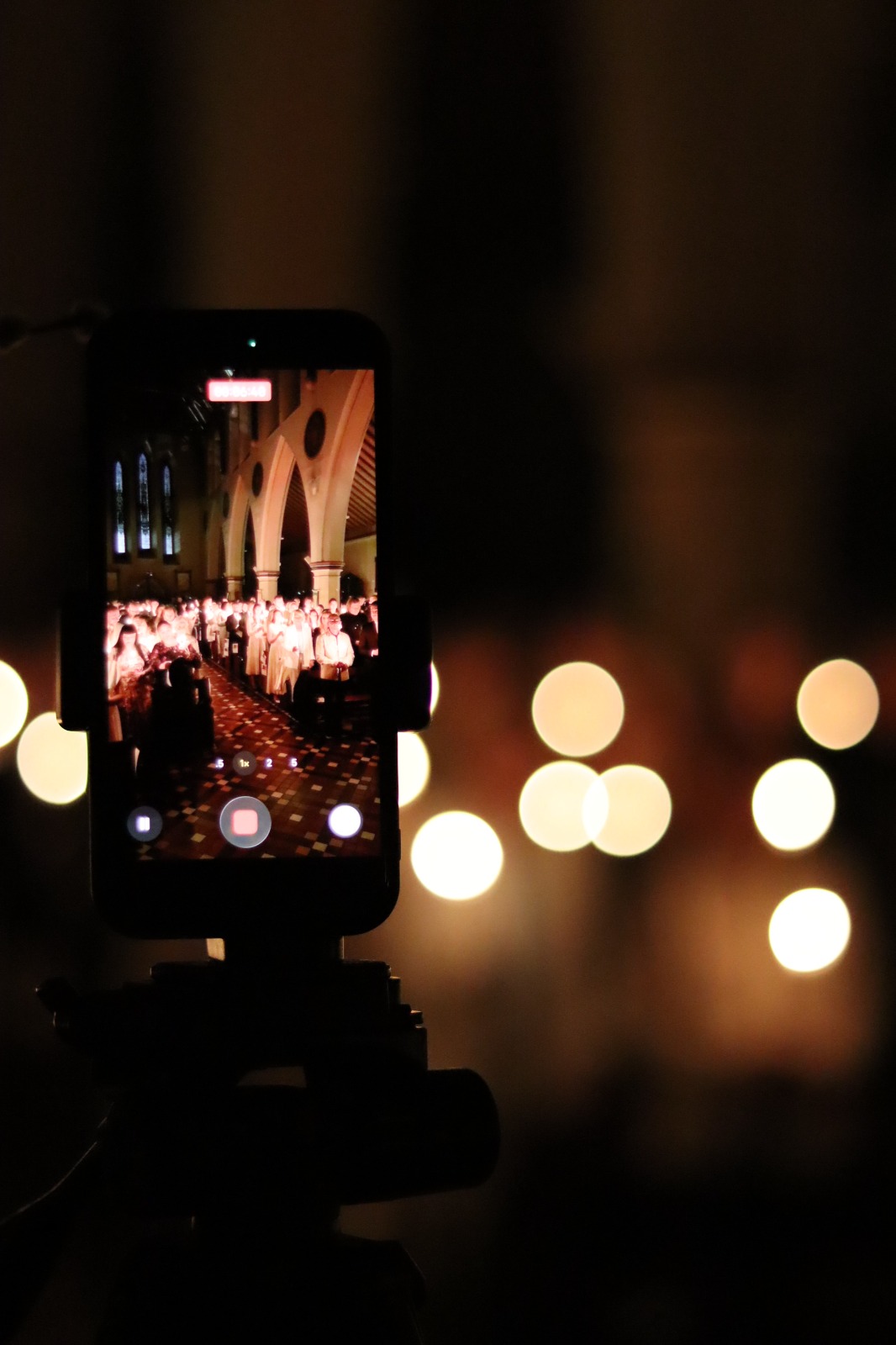
Then he named what their work is. “You are not volunteers helping out the communications office,” he told them. “… You carry a gift of the Holy Spirit, and that gift is meant for us all.” Like a candle lit at the Easter Vigil, he said, “through your phone screen, you are holding a flame of faith out to people who may not yet have seen one.”
Mission in the digital space is new ground for the whole Church, and Bishop Patrick has been learning alongside the missionaries. This autumn he has been recording a weekly series of short prayer videos called So, Lord…? When he was asked to begin with the sign of the cross, he admitted: “I thought, ‘Come on, everybody knows how to make the sign of the cross.’ … Because I’m thinking of those inside. I’m not thinking of the bigger picture.”
Around the table, one of the newest digital missionaries, who had recently become Catholic, said she had not known how to make the sign of the cross. “Thank you for saying that,” the Bishop replied. Since it launched on 9 October, the So, Lord…? prayer series has been viewed nearly 250,000 times.
Each missionary took home A Little Handbook of Digital Mission, opening with Bishop Patrick’s letter calling them “my eyes and my ears”. It shows what encounter, discipleship and mission look like in a parish, with prompts anyone can use.
The handbook comes with the launch of the Digital Mission Lab, a new, ongoing offer from the Diocese’s communications department for parishes taking up digital mission. It responds to the Mission Plan, to the parishes asking for help, and to what the wider Church is beginning to call a charism. Parish communicators can keep coming back to the Lab for support, company and ideas, while each parish tells its own story in its own way.
Liz Gutierrez, the Diocese’s Digital Disciple Maker, now runs drop-in sessions twice a month. There is also a WhatsApp community, a look ahead at each new season and two gatherings a year. The aim, in Bishop Patrick’s words, is that “nobody doing this work is left on their own.”
Bishop Patrick sent them out with the prayer he gives young people at Confirmation. He asked them to pray it each time they pick up their phone to post: “Lord, what today are you and I going to do together?”
If your parish has someone who already shares its life online, or someone who could, this handbook is for them. You can download it below and read it with your parish priest and mission team. Its back page tells you everything you need to join the Digital Mission Lab.

Latest news from
Communications


